Practical guide
Tracking Water Bottle Refills: A Simple Measurement Worksheet
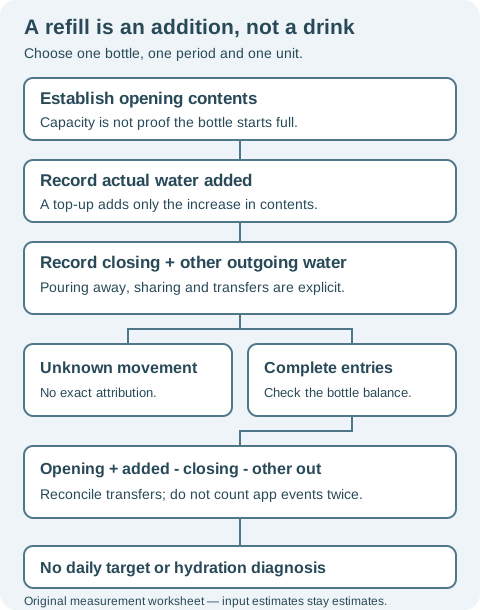
Keep one bottle and one period clear. Count actual additions, subtract leftovers and non-drinking losses, and reconcile transfers or app entries before using the total.
Choose one bottle and one recording period
Refilling a bottle tells you that water went into it. It does not, by itself, tell you how much you drank. The bottle may have contained water before the refill, have water left at the end, or have supplied someone else. Counting every refill as one full bottle can overstate your drinking.
Start with one identified bottle and a clear period, such as breakfast to the end of the workday. Record its opening contents, the water actually added, its closing contents and amounts that left without you drinking them from that bottle. Use the same unit throughout. You can extend the record to another bottle later, but keep transfers explicit.
This is an original measurement worksheet for a record you choose to keep. It does not tell you how much to drink, diagnose dehydration or decide whether a daily target is suitable. You can use it once to resolve a counting question without creating a permanent monitoring habit.
The CDC’s water guidance says that water needs vary and that other beverages and foods also contribute. A plain-water bottle record covers only its stated scope. It is not the same as a complete total-water assessment.
Keep capacity, contents and units distinct
NIST’s volume guide distinguishes capacity from volume and states that 1 L equals 1,000 mL. Capacity is how much the object can contain; contents are what is in it now. A 600 mL bottle can begin the day with only 400 mL in it.
| Record field | What to establish | Avoid this assumption |
|---|---|---|
| Bottle identity | Name or describe the one bottle you are following. | Two bottles with the same nominal size still need distinguishable records. |
| Working capacity | Use a known suitable reference level and its volume. | An advertised maximum is not proof you filled to that amount. |
| Opening contents | Record the water present when this period begins. | An already partly full bottle is not an empty starting point. |
| Additions | Record the amount actually poured in each time. | A top-up from 150 mL to 600 mL adds 450 mL, not 600 mL. |
| Closing contents and other outgoing amounts | Record what remains and what was poured away, shared or transferred out. | Do not assume every disappearance was personal drinking. |
| Units and reading uncertainty | Keep all entries in mL, or convert known L values consistently. | A rough visual reading stays approximate; unknown is not zero. |
Choose a usable reference level rather than assuming a rounded product name is a measurement. If you need to establish an ordinary reference volume, use a suitable marked measuring container according to its instructions and keep the reading approximate where appropriate. This worksheet does not certify the bottle or calibrate your container.
Do not assume a bottle that looks half full contains exactly half its capacity. Its shoulders, base and cross-section can change how height relates to volume. If you cannot establish the remaining amount, mark it unknown or a stated estimate. Do not report extra decimal places as if you measured them.
For this calculator, enter mL only. For example, a known 0.5 L is 500 mL. A label that says only “ounces” needs its unit clarified before conversion; fluid ounces and mass ounces are different, and fluid-ounce systems differ. We do not infer a conversion from an ambiguous bottle marking.
Use a contents balance instead of multiplying the refill count
For one bottle and one period, use:
Amount accounted as personally drunk = opening contents + water added − closing contents − amounts not personally drunk from this bottle.
This is an accounting relationship for complete entries. It is not an independent measurement of your drinking. If an unrecorded spill, shared drink or uncertain remainder is present, the result cannot separate it from consumption.
| Event | Added, mL | Other outgoing, mL | Contents after, mL | How to record it |
|---|---|---|---|---|
| Opening contents | 0 | 0 | 400 | Already in the bottle; record as opening stock. |
| After drinking | 0 | 0 | 150 | Illustrative 250 mL decrease attributed to drinking. |
| Top up to the known 600 mL level | 450 | 0 | 600 | Add only the increase, not another 600 mL. |
| After drinking | 0 | 0 | 300 | Illustrative 300 mL decrease. |
| Pour away some water | 0 | 100 | 200 | This outgoing amount was not personally drunk. |
| Top up to the same level | 400 | 0 | 600 | The second addition differs from the first. |
| After drinking | 0 | 0 | 150 | Illustrative 450 mL decrease. |
| Close the recording period | 0 | 0 | 150 | Closing stock is not an extra drinking event. |
In this invented example, the additions total 450 + 400 = 850 mL. The bottle began with 400 mL, ended with 150 mL and lost 100 mL to pouring away. The balance is 400 + 850 − 150 − 100 = 1,000 mL. The illustrative drinking decreases also total 250 + 300 + 450 = 1,000 mL.
Two top-ups multiplied by 600 mL would give 1,200 mL and miss the opening, closing and poured-away water. Calling them “two refills” is fine as a description of events, but it does not supply their volumes. The remaining-contents column is a sequence of snapshots; do not add those snapshots as drinking amounts.
Four fictional examples show what the same formula can distinguish
These original invented records illustrate arithmetic, not recommended amounts, real drinking observations or tested health outcomes. Each example states the opening, additions, closing and other outgoing amounts so you can see what is being counted.
1. Full refills with water still left at the end
Mara’s 500 mL bottle begins full. She drinks 425 mL and pours away 75 mL, leaving it empty. She refills and drinks 500 mL, then refills again and drinks 375 mL. At closing, 125 mL remains.
Opening 500 + additions 1,000 − closing 125 − other outgoing 75 = 1,300 mL.
Two later refills do not mean only 1,000 mL was available, and three full fills do not mean all 1,500 mL was drunk.
2. Top-ups with different amounts
Jules uses the 600 mL fictional ledger above. The first top-up adds 450 mL, the second adds 400 mL, and the record includes 100 mL poured away.
Opening 400 + additions 850 − closing 150 − other outgoing 100 = 1,000 mL.
Use the actual additions. Do not replace different top-up amounts with the bottle’s capacity.
3. A partly full bottle carried into the next period
Priya’s first period starts with 500 mL and ends with 200 mL, with no additions or other outgoing water. The next period begins with that 200 mL; after it is drunk, 500 mL is added and 100 mL remains at closing.
First period: 500 − 200 = 300 mL. Next period: 200 + 500 − 100 = 600 mL. Combined: 900 mL.
The 200 mL is closing stock once and opening stock next time. It becomes drinking only when it actually leaves that scope as personal consumption.
4. Water shared with another person
Sam begins with 600 mL. Another person receives 150 mL, no water is added, and 100 mL remains at the end. All other decreases in this invented record are Sam’s drinking.
Opening 600 + additions 0 − closing 100 − shared 150 = 350 mL.
Shared water must not be attributed to Sam. If the shared amount is unknown, the personal-drinking result is also uncertain.
Copy the recording method, not an example’s amount. A person’s prescribed fluid instructions, illness, age or circumstances cannot be inferred from an invented bottle record.
Calculate the balance only when all five entries are known
This optional calculator applies the balance above. Enter known zero where there was genuinely no addition or other outgoing water. Leave an uncertain amount unresolved; the calculator will not treat a blank as zero. Additions can exceed one bottle’s capacity across several refills, while opening and closing contents must fit its stated working capacity.
Enter numbers without units or commas, with up to three decimal places. The arithmetic preserves the entered numbers; it does not make your readings equally precise. The result includes mL and L and does not give a target, remaining “quota” or health score.
If closing contents plus other outgoing amounts exceed opening contents plus additions, the entries do not balance. Recheck the period, units and missing events instead of clamping the result to zero. The calculator checks those totals and capacity bounds; it does not verify every event’s order or establish that all unrecorded losses were drinking.
Everything stays in this page’s fields. It does not ask for body weight, medical information or an account, and does not store or submit the record. Clearing the fields returns to an empty record, not a claim that you drank nothing.
Reconcile transfers and carry-over before combining records
If water moves from Bottle A to Bottle B, identify the transfer in both separate bottle records. It is not drinking from A and not newly created water. The following invented pair uses the same 200 mL transfer once as A’s outgoing water and once as B’s incoming water.
| Bottle | Complete entries | Accounted as personally drunk | Transfer boundary |
|---|---|---|---|
| Bottle A, capacity 500 mL | Opening 500; additions 0; closing 100; 200 transferred to B. | 500 − 100 − 200 = 200 mL. | Transfer out is not personal drinking from A. |
| Bottle B, capacity 300 mL | Opening 0; 200 received from A; closing 50; no other outgoing. | 0 + 200 − 50 = 150 mL. | The receipt is an addition to B; it is the same transferred water. |
The two personal-drinking results total 200 + 150 = 350 mL. As a combined two-bottle scope, there were 500 mL at opening and 150 mL at closing, with no external additions or other losses: again 350 mL. Internal transfers cancel. Do not add “200 mL transferred” as another drinking event on top of that total.
Likewise, close one period and carry its remainder into the next period’s opening contents. If you already logged individual drinking events in an app, do not also add the whole calculated period result as a new drink. Choose one counting method for the total, or reconcile the two as a check without summing both.
BOTTLE RECORD — SCOPE AND REFERENCE
Bottle identity and working capacity:
Reference level and unit; measured, estimated or unknown:
Period begins / ends:
Opening contents:
Addition events: time / actual amount added:
Other outgoing: time / poured away, shared or transferred:
Closing contents:
Uncertain readings or unrecorded events:
Choose one method: bottle balance OR drinking-event entries.
This record does not choose a personal drinking target.
PERIOD REVIEW — KEEP COUNTING METHODS SEPARATE
Sum of actual additions:
Sum not personally drunk from this bottle:
Opening + additions - closing - other outgoing:
Result or “cannot separate drinking from unknown losses”:
Other bottle records; internal transfers reconciled:
Other drinks/foods are outside this plain-water bottle scope:
Estimated inputs remain estimated; do not invent precision.
No hydration diagnosis or clinical approval follows.
Download the blank records, complete fictional ledger, examples and answer notes. Keep only the detail needed for your counting question. The reminder planner concerns cues and timing; a planned refill is not a completed drinking record.
Keep unknown losses and health questions outside the calculated total
Unknown spills, shared use and uncertain remaining volume prevent an exact attribution to drinking. Write the gap down. Setting every unknown to zero creates a tidy number but changes what the number means. You can stop at “the record is incomplete” and use a simpler scope next time.
Ice, added ingredients and liquids from several containers complicate the contents reading. Do not treat the height of an ice-water mixture as a verified liquid-water volume, or invent a melted-ice conversion from the number of cubes. This worksheet is simplest for one bottle of plain liquid water with known additions and outgoing amounts.
CDC explains that other drinks and foods contribute to total water and that needs vary by age, activity, pregnancy and breastfeeding, among other factors. This record does not assess those needs. It also does not determine whether the water source, bottle cleaning or a prepared product is suitable.
NHS dehydration guidance describes illness-related fluid loss and when to seek care. Do not delay needed help to finish a bottle calculation. Serious symptoms such as confusion, difficulty waking or breathing problems need urgent assessment through the appropriate local service. Follow any clinician’s fluid instructions; this worksheet does not replace a prescribed recording method or set a new allowance.
For ORS, use the exact product’s mixing instructions and appropriate professional advice. A water-balance result does not choose the powder-to-water ratio, amount to give or care urgency. The ORS packet instruction guide covers that separate preparation task. The electrolyte label calculator likewise calculates a stated nutrient basis, not a personal drinking target.
Six checks before treating a refill record as a drinking total
Try these original cases before opening the answers. They test volume accounting and the record’s limits, not anyone’s hydration status.
Case 1
A 600 mL bottle has 150 mL left before it is topped up to the known 600 mL level. How much should the addition entry be?
Show answer and explanation for case 1
450 mL added.
The addition is the increase in contents: 600 − 150. Recording 600 mL would count the existing 150 mL again.
Case 2
A bottle starts with 500 mL, receives 1,000 mL during the period, ends with 125 mL, and has 75 mL poured away. What does the complete balance give?
Show answer and explanation for case 2
1,300 mL accounted as personally drunk from this bottle.
500 + 1,000 − 125 − 75 = 1,300. This is arithmetic from the stated complete record, not a recommendation or independent health measurement.
Case 3
Yesterday’s record subtracted 200 mL left at closing. Today starts with that same 200 mL. Is writing it as today’s opening stock automatically double-counting drinking?
Show answer and explanation for case 3
No. Opening and closing stock are not themselves drinking events.
The remainder was excluded from yesterday’s consumption. It can be included as today’s opening stock, with today’s actual additions, closing contents and other outgoing amounts.
Case 4
Some water was spilled, but the amount is unknown. Should the other-outgoing field be zero so the calculator can finish?
Show answer and explanation for case 4
No. Keep the loss unknown and the attribution unresolved.
Zero means a known absence of other outgoing water. An unknown spill cannot be separated from drinking by the bottle balance alone.
Case 5
You log every drink in an app and also calculate a 1,000 mL period balance from the same bottle. Should you add another 1,000 mL app entry?
Show answer and explanation for case 5
No. Reconcile the two methods without summing both.
Both records concern the same consumption. Adding the period total to its individual drinking events would duplicate it.
Case 6
The calculator returns a positive volume. Does that prove you reached a suitable daily-water target or have no dehydration?
Show answer and explanation for case 6
No. It establishes neither conclusion.
A bottle record has a limited scope, depends on complete inputs and excludes other food/drink contributions. Personal needs, symptoms and clinical instructions are separate questions.
Sources and further reading
- NIST: SI Units — Volume (updated 2 March 2026)Capacity and volume vocabulary and 1,000 mL = 1 L. This source does not certify a bottle, its marks or the accuracy of your record.
- NHS: Dehydration (reviewed 1 May 2026)Illness-related fluid loss and appropriate care boundaries. A volume worksheet does not diagnose dehydration, select ORS or choose an amount to give.
- CDC: About Water and Healthier Drinks (5 March 2026)Water needs vary; other beverages and foods contribute to total water. This limited plain-water record does not choose a personal intake target.