Practical guide
ORS Packet Instructions: Why the Stated Water Volume Matters
An ORS sachet is intended for a specified amount of water. Use the amount on that exact packet and leaflet, with its complete preparation and storage directions. A familiar one-litre example, an unmarked mug or the number of sachets in a carton cannot replace those instructions. Mixing a packet correctly and deciding how much someone should drink are separate tasks.
A sachet does not have one universal water volume
The CDC Yellow Book says packaged oral rehydration salts are prepared with the water volume indicated for the packet, “generally 1 L.” That wording is an example within its travellers’ diarrhoea guidance. It does not say that every ORS sachet must be mixed into one litre. [1]
A real counterexample is the UK Dioralyte Blackcurrant sachet discussed below: its patient leaflet specifies 200 mL of water for one sachet. These two statements are compatible when you keep the exact product attached to the instruction. They are not a reason to average the amounts or choose whichever container is convenient.
This guide is a label-reading aid. For ORS suitability, symptoms and the amount to give, ask a pharmacist or clinician. For a broader introduction, read when ORS is used and when care comes first. No homemade formula or individual treatment plan is provided here.
Read one real product example: Dioralyte Blackcurrant
We checked the patient leaflet linked from the eMC Dioralyte Blackcurrant Sachets (GSL) entry, together with its Summary of Product Characteristics. The leaflet covers Natural, Citrus and Blackcurrant versions and states that it was revised in June 2023; eMC lists an update on 18 January 2024. Check the leaflet in your current pack, which may differ. This is a document example, not a product tested or photographed by this site.
| Instruction to read | What the leaflet says | Keep separate |
|---|---|---|
| Powder amount | Empty the contents of one sachet. | The number of sachets in the carton. |
| Water to add | 200 mL, also written as approximately 7 fl oz. | The person’s advised drinking amount. |
| Liquid | Only dissolve the powder in water. | A drink you would prefer for flavour. |
| Mixing | Stir until the powder dissolves. | Appearance as proof that the water quantity was correct. |
| Prepared drink | Make just before use; discard the remaining drink after one hour, or 24 hours if stored in a refrigerator. | A storage rule remembered from another product. |
| Unopened product | Store below 25°C in the original package, protected from moisture; check expiry. | The prepared drink’s discard time. |
The source leaflet has further warnings, age-specific water guidance and dosing information. This table selects preparation and storage details; it does not replace the full leaflet. [2] [3]
Why more or less water changes the preparation
The sachet supplies a set amount of powder. If you change the water amount while keeping that powder, you change the powder-to-water proportion. Less water makes it stronger; more water makes it weaker. That is not the same as choosing a different serving from a correctly prepared solution.
The Dioralyte leaflet explicitly says not to use more or less than 200 mL: it may not work as well and may upset the balance of salts in the body. Its professional information explains that a weaker solution does not have the optimal glucose and electrolyte concentration and a stronger one may cause electrolyte imbalance. [2] [3]
Do not add sugar, salt or another supplement to make an ORS match a different product. Nor should you use a sports-drink mixing range as an ORS rule. The separate ORS and sports-drink comparison explains why shared ingredients do not make their purposes and directions interchangeable.
Keep water units beside the number
One litre is 1,000 millilitres. Therefore 200 mL = 0.2 L. If your measuring jug is marked in litres, use the corresponding 0.2 L mark for that stated 200 mL amount. Do not confuse it with 2 L, 0.2 mL or a cup of unspecified capacity.
The Dioralyte leaflet’s fl oz figure is approximate. Fluid-ounce systems and household cup sizes can differ, so a bare “seven ounces” or “one glass” is not a clear measurement. A marked mL container lets you follow the explicit 200 mL instruction without relying on a remembered cup size.
Read whether the instruction specifies the water to add. This leaflet says to add 200 mL of water to the sachet contents; do not use the powder’s height in a glass as a volume mark. Measure the water, use a clean mixing container and follow the actual order and mixing directions.
If you cannot read the units or do not have a suitable way to measure them, ask a pharmacist before improvising. This is a preparation check, not a reason to delay urgent care.
Use five checks before preparing the drink
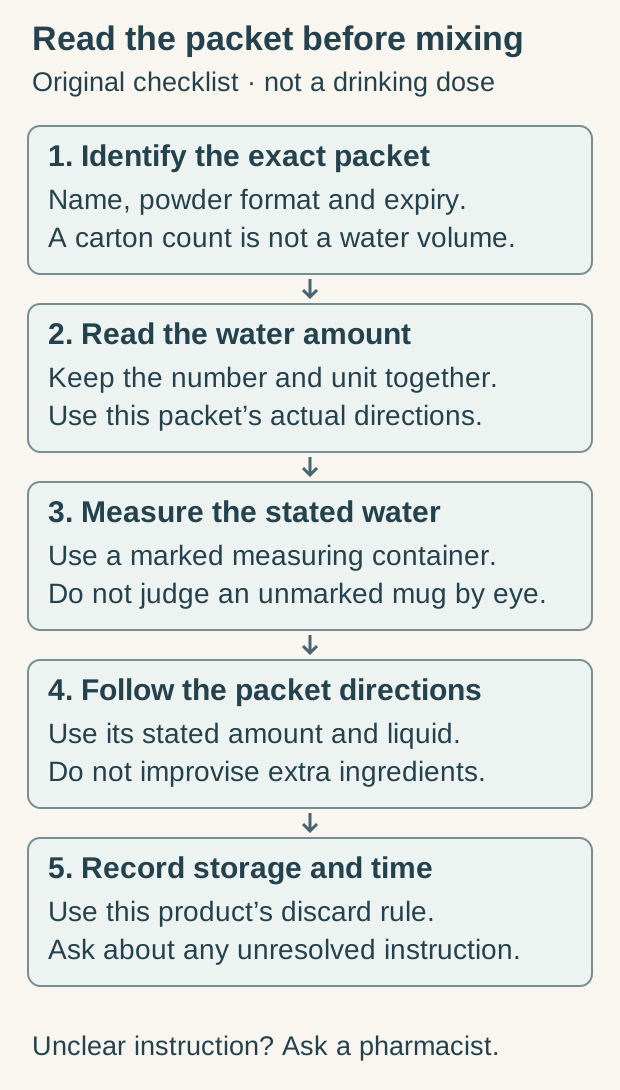
Download the original checklist (SVG) or use the editable instruction record (TXT).
- Identify the packet. Match the product name, flavour and powder format. Check expiry and suitability instructions.
- Read the complete water instruction. Copy its number and unit together. A carton labelled 6 or 20 sachets is telling you a pack count.
- Measure the water stated. Use the required water quality and a marked measuring container.
- Follow the preparation directions. Use the specified sachet amount and liquid; do not estimate a powder fraction or add ingredients.
- Record preparation and storage. Keep the preparation time, conditions and discard instruction together, especially if another person may use the batch.
A package photo or product name alone is not enough when the mixing text is unreadable. Do not copy the amount from another flavour, market, packet size or ready-to-use bottle unless the actual instructions establish that it applies.
Do not turn the water amount into a drinking dose
“One sachet in 200 mL” describes how this product is prepared. It does not by itself say that every person should drink exactly 200 mL, finish a whole carton or use a fixed number of sachets each day. The amount to give depends on the person and the relevant clinical instructions.
Do not estimate half a sachet to create a child-sized drink. Read the complete-sachet preparation rule and obtain age-appropriate advice about the prepared liquid. The Dioralyte leaflet says children below age two require a doctor’s guidance. Its warnings also ask for advice with chronic or persistent diarrhoea, liver or kidney disease, diabetes, or a low-sodium or low-potassium diet. Read the full product warnings rather than treating this as an exhaustive list. [2]
Instructions for dissolving powder are separate from infant-feeding advice and other medical care. If advice from your clinician and a product document appears inconsistent, ask the clinician or pharmacist to clarify the actual situation.
Do not use taste or appearance to fix an uncertain batch
The Dioralyte leaflet describes the fully dissolved drink as colourless. That does not prove that the powder amount, water amount or storage time was correct. Taste is also not a measuring method.
If the water was guessed, powder was spilled, ingredients were added or the preparation time is unknown, do not try to repair the batch by eye. Ask a pharmacist what to do; when the existing preparation cannot be confirmed, prepare a fresh batch correctly. Do not remove a few sips or add salt and sugar to rebalance it.
For this product, the one-hour or refrigerated 24-hour rule concerns the prepared drink. It is different from an unopened sachet’s expiry date. Refrigeration does not turn an already uncertain history into a verified one. The professional information also says the solution itself must not be boiled. Water preparation and heating an already mixed solution are different actions. [3]
Other ORS products may have different directions. Keep their actual water, storage and discard instructions rather than importing this example’s rules.
Six packet-reading cases with explained answers
These original cases check instruction reading. They do not assess dehydration or prescribe a quantity to drink.
Case 1
A website says ORS packets generally use 1 L. Your exact Dioralyte leaflet says one sachet in 200 mL of water. Which statement sets this product’s water amount?
Show answer and explanation for case 1
Use the exact product’s 200 mL instruction.
The CDC’s generally-one-litre example is not a universal packet size. It does not override the actual sachet and leaflet or let you transfer instructions between products.
Case 2
Your measuring jug is marked in litres. The sachet says 200 mL. Which litre mark expresses that same amount?
Show answer and explanation for case 2
0.2 L equals 200 mL.
One litre is 1,000 mL, so 200 ÷ 1,000 = 0.2. This converts the same stated water amount; it does not change the powder or determine how much the person should drink.
Case 3
The carton contains 20 sachets. Does the number 20 mean that one sachet needs 20 mL or that all sachets should be mixed together?
Show answer and explanation for case 3
No. It is a pack count.
Read the per-sachet preparation instruction. This Dioralyte leaflet lists packs of 6 and 20, while each sachet is prepared with 200 mL of water. The carton count is neither the water volume nor a drinking dose.
Case 4
You want a stronger drink to work faster, or a sweeter drink made with juice. Do the packet-reading checks support either change?
Show answer and explanation for case 4
No. Follow this product’s water-only, fixed-volume directions.
Its leaflet warns against more or less than 200 mL and using a liquid other than water. Do not add ingredients or redesign the concentration; ask a pharmacist about suitability.
Case 5
You estimate half a sachet into a small mug because the person is a child. Is a smaller preparation the same as an appropriate drinking dose?
Show answer and explanation for case 5
No. Do not infer a child’s dose by splitting the powder.
Packet preparation and the amount to give are separate questions. Follow the complete-sachet instruction and obtain age-appropriate advice; this Dioralyte product requires medical guidance below age two.
Case 6
A prepared mixture looks clear, but you cannot confirm the water amount or when it was made. Is its appearance enough to use it?
Show answer and explanation for case 6
No. Appearance does not verify the preparation or storage history.
Do not guess the concentration or age of the batch. Ask a pharmacist what to do, and prepare a fresh correctly measured batch when the existing preparation cannot be confirmed. Urgent symptoms take priority.
Get help when symptoms take priority
The NHS advises urgent medical help for signs such as persistent dizziness on standing, much less urine, unusual drowsiness, rapid breathing or a fast heart rate, and a child with fewer wet nappies or few tears. Confusion, difficulty waking, difficulty breathing, or cold, blue, grey, pale or blotchy skin can be emergency warning signs. Use the appropriate local urgent or emergency service. [4]
A product’s 24–48-hour instruction for symptoms that persist is not permission to wait when urgent signs are already present. Keep the packet and explain how it was mixed when asking for advice. A clear label record helps communicate facts; it does not make home preparation suitable for every degree of fluid loss.
Sources and further reading
- CDC Yellow Book: Travelers’ Diarrhea — oral rehydration therapyPacket-specific indicated water volume, with generally 1 L as an example rather than a universal sachet rule.
- Dioralyte patient information leaflet linked from eMC product 2775 (PDF)Complete leaflet: one sachet plus 200 mL water, water-only preparation, warnings about more or less water, storage, expiry and age-specific advice.
- eMC: Dioralyte Blackcurrant — Summary of Product CharacteristicsSections on reconstitution, weaker or stronger concentration, water-only use, prepared-solution storage and not boiling the solution. The clinical dose is not reproduced here.
- NHS: DehydrationPharmacist advice about suitable ORS and urgent or emergency signs; these override a label-reading exercise.